Burntollet Bridge attack
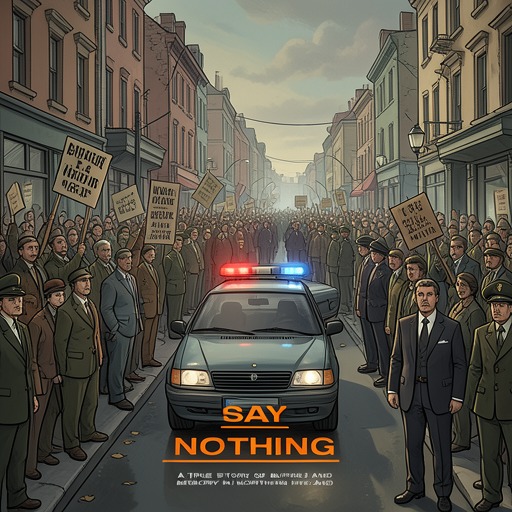
Say NothingThe Burntollet Bridge attack was an assault on civil-rights marchers travelling from Belfast to Derry in January 1969. Its significance extended beyond the immediate violence: for Dolours Price, the attack helped turn a commitment to peaceful protest into a conviction that armed struggle was necessary, while the march itself had tested whether young people could challenge entrenched injustice without reproducing the divisions around them.
Background and the March
On 1 January 1969, students assembled outside City Hall in Donegall Square, Belfast, and set out on a roughly seventy-mile march to Derry. They were protesting discrimination against Catholics in Northern Ireland, where Catholics were often excluded from good jobs and housing and had little access to political power. The march was intended to take several days, carrying the civil-rights campaign from the city into communities along the route.
The procession passed through Protestant villages that were unionist strongholds. Local men came out with sticks to block the marchers, while police accompanying the procession directed it around the villages. Men associated with Major Bunting walked alongside, taunting the students; one beat a Lambeg drum, whose sound summoned other counter-protesters. The marchers had seen the televised police response to the Selma march and some believed that peaceful protest, even when met with violence, could expose injustice and provoke change. They hoped the conflict might be reframed as a struggle between young and old rather than Catholics against Protestants or republicans against loyalists.
The Attack at Burntollet Bridge
On the march’s fourth and final day, at a crossroads about ten miles outside Derry, the danger was put to the marchers plainly. A speaker warned through a megaphone that stones might be thrown and asked whether they were prepared to be hurt. Hundreds of people now filled the road; they answered yes. The exchange made the march’s commitment to nonviolence concrete: the participants understood that continuing might mean injury, but did not treat that risk as a reason to turn back.
At Burntollet Bridge, that risk became an assault. The attackers, some wearing motorcycle helmets, descended on the marchers; contemporary accounts describe a curtain of projectiles and the crowd breaking apart as people fled. The violence was not simply a clash along a country road. It exposed how vulnerable a peaceful procession could be when local hostility met the failure to protect its participants, and it made the march’s hopes of winning change through nonviolent witness newly precarious.
From Protest to Armed Politics
The attack’s most consequential personal aftermath unfolded over the next two years. Dolours Price returned to school, then began studying education at St Mary’s Teacher Training College in 1970. She had once hoped to attend art school, but the experience at Burntollet Bridge had changed her understanding of what peaceful protest could achieve. She came to believe that marching alone would not bring the change Ireland needed; joining the Irish Republican Army would later feel to her like a return to her family’s republican inheritance.
In 1971, Price approached a local commander and asked to join. Her induction took place in the front room of the family home on Slievegallion Drive, where she swore allegiance and promised to obey orders from a superior officer. Her mother sat in the next room, apparently unaware of the ceremony. Marian Price joined as well. The sisters continued attending school, while keeping their nighttime activities from their family, reflecting the secrecy surrounding membership in a banned organization.
Price’s decision also challenged the role assigned to women within republicanism. Seán Mac Stíofáin initially proposed that she join Cumann na mBan, the women’s auxiliary, but she wanted to serve as a fighting soldier rather than provide support. A special meeting of the Provisionals’ Army Council then decided that women could join as full members for the first time. Price’s insistence was likely an important force behind the decision; she also later suggested that the mass imprisonment of men may have made the organization more willing to admit women. The change in status did not spare her from menial work: soon after her induction, she was ordered to scrub a heap of rusty bullets with steel wool. She complied, treating obedience to the order as part of the test.
The shift from protest to armed activity did not determine Price’s entire political course. A decade later, after abandoning violence as her own means of pursuing Irish unity, she canvassed for Sinn Féin and supported Gerry Adams’s 1983 Westminster campaign. That later turn makes the march’s legacy more complicated than a simple conversion from nonviolence to militancy: political methods changed, while the struggle over how to achieve Irish unity continued.
The Attack in Retrospect
The book treats Burntollet not as an isolated eruption but as a moment whose meaning continued to change as its consequences unfolded. For Dolours Price, the assault became a dividing line in her political understanding: peaceful protest, which she had believed could overcome injustice, no longer seemed sufficient. Yet the narrative does not make the attack a complete explanation for her later choices. Her family’s republican inheritance, the discrimination that had brought the march into being, and her own demand for a direct military role all belong to the larger sequence. Burntollet gave those forces a particular direction; it did not reduce them to a single cause.
That distinction matters in a book concerned with how conflict survives as memory. The epigraph’s image of wars being fought again in recollection applies to Burntollet: the march’s immediate hope of exposing injustice through peaceful action is read alongside the later turn toward armed struggle, and neither erases the other. The attack thus marks both the vulnerability of civil-rights protest and the cost of interpreting violence as proof that nonviolence has failed. In the years after the conflict, political accounts of the past remained contested, while public tours and murals could make the Troubles seem distant even as divisions endured. Burntollet’s place in the narrative resists that distance. It remains a remembered encounter between a movement seeking change through public witness and a society in which the conditions for such witness were themselves violently contested.